
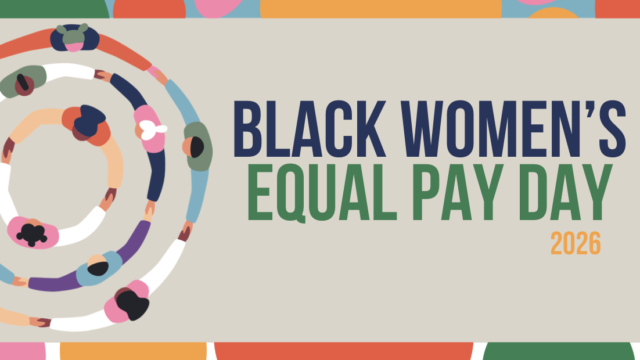
Over the last few years, because of the actions of our leaders, New York has taken concrete actions to close the pay gap with stronger laws and worker protections. Yet, today Black women in New York only earn 66 cents for every dollar a white, non-Hispanic man makes. Over a 40-year career, Black women in New York stand to lose $1,161,160 in wages due to this wage gap. That means Black women must work until age 81 to catch up to earnings a white man would make by 60. We highlight Black women’s pay equity now because, due to the wage gap, it would take Black women all the way until July 21, 2026 to earn what men earned in 2025. Thank you to our New York leaders for speaking out about this persistent, systemic wage inequality!
Scroll down for Black Women’s Equal Pay Day statements and videos.
Sister to Sister International
NYS Majority Leader Andrea Stewart-Cousins | “Black Women’s Equal Pay Day remains an important reminder that the fight for pay equity is far from over. Across our country, Black women continue to face unacceptable wage disparities, despite making invaluable contributions to our workforce, our communities, and our economy. The Senate Democratic Majority remains steadfast in our commitment to advancing policies that promote equal pay, strengthen workplace protections, expand economic opportunity, and ensure every New Yorker is treated fairly on the job. Black women deserve nothing less than equal pay for equal work, and we will continue to fight until that becomes a reality. I want to thank PowHer New York for their leadership and advocacy on this issue, and I look forward to continuing our partnership as we work toward economic justice and equal pay for all.”
NYS Senator Shelley Mayer | “I am proud to join PowHer New York in recognizing Black Women’s Equal Pay Day. It is deeply troubling that Black women continue to face persistent wage disparities, rooted in racial, gender, and economic discrimination. New York will continue fighting, especially in light of the federal government rolling back DEI initiatives, to close wage gaps, strengthen workplace protections, and ensure Black women are paid fairly for their work and are treated with the dignity and respect they deserve. I am deeply grateful to Senate Majority Leader Andrea Stewart-Cousins for her extraordinary leadership in advancing policies that push New York forward and continue to make meaningful progress.”
NYS Senator Samra Brouk | “Year after year, the wage gap persists. To this day, Black women in New York State only earn 66 cents for every dollar a white, non-Hispanic man makes. I proudly join PowHer New York in fighting to close the historic wage gap that is driven by gender and racial economic inequities. We must support common sense solutions and give women the overdue dignity and compensation they deserve.”
NYS Senator Nathalia Fernandez | “On Black Women’s Equal Pay Day, we recognize that equal work deserves equal pay. While New York has made important progress through measures such as pay transparency and salary history protections, too many Black women continue to face persistent wage disparities that limit economic opportunity for themselves and their families. We remain committed to advancing policies that promote fair pay, increase transparency, strengthen worker protections, and expand access to economic opportunity for all New Yorkers. Closing the wage gap requires continued action, accountability, and investment in working families. Together, we can build a more equitable future where every person’s work is valued and compensated fairly.”
NYS Assemblymember Harry B. Bronson | “As Chair of the Assembly Labor Committee, my priority is ensuring every worker is treated with dignity and fairness in the workplace. On this Black Women’s Equal Pay Day, I stand with the hardworking women of New York and PowHer NY in confronting a wage gap that still shortchanges Black women by tens of thousands of dollars a year. This work continues until every woman is paid equitably in every workplace.”
NYS Assemblymember Alicia L. Hyndman | “Black women have been the backbone of American society since the founding of this country, but despite how much we have progressed, we are still making pennies on the dollar in comparison to white women, and especially white men,” said Assemblywoman Alicia L. Hyndman, Member of the Assembly Committee on Economic Development, Job Creation, Commerce and Industry. “We have fought for everyone throughout the nation and now we need our families, friends, neighbors and even strangers to fight for us by advocating for the passage of NYC Int. 144, and for the passage of NYS A5906A/S5990A in the next session. These transparency laws will require employers to stop infringing on the salaries of Black women who will lose out on more than $1 million in earnings due to wage gaps, in which we make 66 cents for every dollar a white man makes. We have progressed a lot over the past 250 years in this country, but much more still needs to be done in terms of pay equity for Black women.”
NYS Assemblymember MaryJane Shisky | “Equal pay is about fairness, economic opportunity, and ensuring everyone can build a secure future for themselves and their families. Yet in 2026, Black women still earn just 66 cents for every dollar earned by non-Hispanic white men. By advancing policies that promote salary transparency, strengthen pay equity, and support living wages, we can close the gap and help build a New York where every worker can thrive.”
NYS Assemblymember Nikki Lucas | “As a Black woman, I know all too well that Black Women’s Equal Pay Day is far more than a symbolic observance. It serves as a powerful reminder that we must continue dismantling the systemic barriers that devalue the work of Black women and deny them the equal pay they have rightfully earned,” said Assemblywoman Nikki Lucas of the 60th Assembly District, which includes East New York, Starrett City, Brownsville, and Canarsie. “I am proud to stand with NY POWHER in raising awareness of the persistent wage gap that continues to affect all women across this country, while disproportionately impacting Black women. Pay inequality doesn’t just shortchange Black women – it limits opportunity, perpetuates poverty, and widens the racial wealth gap. Equal pay is not just about fairness – it is about economic justice, strengthening families, and creating opportunities for future generations.”
Bronx Borough President Vanessa L. Gibson | “Every day, Black women help move this borough and our nation forward as leaders, entrepreneurs, educators, healthcare workers, caregivers, public servants, and so much more. Yet far too many continue to be denied the fair compensation they have earned for the indispensable contributions they make to our communities. As the first woman and first African American to serve as Bronx Borough President, I believe economic equity is fundamental to the future of our borough. As we continue building a borough and city where everyone has the opportunity to succeed, we must ensure that Black women are valued, not only through words, but also through fair wages, equal opportunity, and policies that ensure they are paid what they have rightfully earned.”
NYC Council Deputy Speaker Dr. Nantasha Williams | “I know the talent, discipline, and leadership Black women bring to every workplace, and I also know how often that value is discounted in our paychecks and our opportunities. In 2025 alone, Black women lost 113,000 jobs nationally, even as the wage gap continued to limit our ability to build wealth and long-term financial security. That is why I worked to strengthen New York City’s pay transparency law, giving workers clearer information to evaluate opportunities and advocate for fair compensation. Transparency is an important tool, but the measure of our progress is whether it leads to greater stability, mobility, and equity for Black women. We must continue strengthening workplace protections, investing in the care economy, and defending the data and enforcement systems that allow us to identify and confront discrimination.”
Deputy Whip of the New York City Council, Elsie Encarnación | “Black Women’s Equal Pay Day marks how long Black women have had to wait for pay they’ve already earned and deserve. Behind that wait is a mother choosing between rent and childcare, a grandmother still working into her 80s because she was underpaid for decades. That’s not the free market, but generations of policy choosing to undervalue Black women’s work. We can choose differently: we need real pay transparency, real investment in caregivers, and no rolling back the accountability tools we’ve fought to win. Black women in New York have waited long enough.”
NYC Council Member Amanda Farias
NYC Council Member Farah N. Louis | “Black women serve as the foundational pillars of their families, yet to this day continue to experience severe wage gap disparities driven by gender and race discrimination. It is appalling that in 2026, a Black woman must work an extra year to match the salary a white man earned the previous year,” said Council Member Farah N. Louis. “It is critical that our government guarantees equitable pay to Black women, who earn 64 cents for every dollar earned by white men. I am proud to bring my lived experience to policymaking and help shape policy decisions regarding pay equity and economic justice for marginalized women, and I thank PowHerNY for their dedication to secure economic equity and financial security for Black women.”
NYC Council Member Sandy Nurse | “Before I became a Council Member, I worked as a dishwasher, carpenter, and delivery worker so I know what it is like to be underpaid for your labor as a Black Woman,” said Council Member Sandy Nurse. “It’s up to all of us to address this chronic injustice by creating avenues for greater pay transparency and an increase to wages in our city. By working to address the pay of Black Women who make up a large part of the care and minimum wage workforce, we will bring everyone up to a more equitable level.”
NYC Council Member Rita C. Joseph | “Black Women’s Equal Pay Day is a stark reminder that despite generations of leadership, innovation, and sacrifice, Black women are still not paid what they have rightfully earned. In New York, Black women earn just 66 cents for every dollar earned by a white, non-Hispanic man an injustice that costs them more than $1.1 million over the course of a 40-year career. That is money that could be invested in housing, education, healthcare, entrepreneurship, and building generational wealth for families and communities. As a Black woman, an educator, and public servant, I know that when Black women thrive, our families, neighborhoods, and our city thrive. Yet the reality that Black women would have to work until age 81 to earn what a white man earns by age 60 is unacceptable. Equal work deserves equal pay. We must continue advancing policies that promote pay transparency, strengthen workplace protections, expand economic opportunities, and eliminate the systemic barriers that have denied Black women the wages and respect they deserve. Black Women’s Equal Pay Day is not just about acknowledging inequity it is a call to action to build an economy rooted in fairness, dignity, and justice for all.”
NYC Council Member Susan Zhuang | “As an immigrant, a mother, and the daughter of a small business owner, I know what it means to work hard and still come up short because the system was not built with fairness in mind. Black women in New York are still paid 66 cents for every dollar paid to a white man, and that gap follows them their entire career, into retirement, and into old age. This is not just a workplace issue, it is a care economy issue. When we underpay the women who do so much of the caregiving in our city, we weaken the very foundation that families and older adults depend on. I stand with the New York Equal Pay Campaign in calling for stronger pay transparency laws, an expanded care workforce, and real investment in paid leave, because equal pay for Black women is long overdue.”
NYC Council Member Gale A. Brewer | “Black Women’s Equal Pay Day is a reminder that, while we have made progress, Black women are still not paid what they deserve. In New York, Black women earn just 66 cents for every dollar earned by a white, non-Hispanic man. This inequity makes it harder to afford housing, support a family, and build long-term financial security.I have worked for a long time to expand paid sick leave and support working women. As Co-Chair of the City Council’s Women’s Caucus, I know there is more work to do. Closing the wage gap is not just about fairness—it is essential to making New York more affordable for women and families.”
Simone Jones, Deputy Chief of Staff to NYC Council Speaker Menin and Chief Equity Officer | “As a Black woman, government leader, and mother, I am proud to stand with PowHER and advocates across New York in recognizing Black Women’s Equal Pay Day and reaffirming our commitment to closing the wage gap. The persistent disparities in pay experienced by Black women are not only an economic issue, they are an equity issue. They reflect longstanding systemic barriers that require intentional action through policy, transparency, accountability, and investment in opportunity. Every New Yorker deserves the ability to earn fair pay for their work and build economic security for themselves and their families. The New York City Council has taken meaningful steps to advance pay equity through legislation and advocacy, and as the Council’s first Chief Equity Officer, I remain committed to ensuring that equity remains at the center of our work. Together, we must continue strengthening pay transparency, supporting the care workforce, and advancing policies that create lasting economic opportunity for all. I commend PowHER and the many leaders, advocates, and organizations who continue to champion this work. I look forward to the day when Equal Pay Day is no longer a reminder of the work ahead, but a celebration of the equity we have achieved for future generations.”
Seher Khawaja, National Economic Justice Director, Equal Pay Today | “The significant wage gap for Black women should be an urgent call to action for policymakers in New York State. We need to invest in an agenda that increases pay transparency, raises the wage floor, ends the segregation of Black women in lower-paid industries, establishes broad caregiver protections, and strengthens anti-discrimination and labor enforcement.”
Juliet Armstrong, Board Member, Westchester Women’s Agenda | We shouldn’t need a Black Women’s Equal Pay Day—but we still do. In fact, for Black women, the pay gap grows—not shrinks—with higher levels of education. We’ve made real progress, and New York has led the nation in advancing equal pay. But we can’t settle for progress when equality is the imperative. That’s why Black Women’s Equal Pay Day matters.
Antoinette Gillard, Westchester Women’s Agenda | When we talk about affordability, we usually talk about rising prices. But we don’t talk enough about women’s pay that hasn’t kept up. Black women still earn just 63 cents for every dollar earned by a white man. Imagine what equal pay could mean: not having to work that second job, making one less impossible trade-off, and having a little more peace of mind. That’s why Black Women’s Equal Pay Day matters.
Angel Gray, Board Member, Westchester Women’s Agenda | “Black Women’s Equal Pay Day reminds us that building a more affordable New York starts with equal pay.”
Sharon Sewell-Fairman, President & CEO Women Creating Change | “Equality should be the standard, not something we continually have to fight for. People deserve equal pay for equal work, regardless of their race, gender, background, or culture. The cost of food, housing, and other necessities does not decrease because someone is paid less, and wages should reflect that reality. WCC’s Unequal Ground report found that Black women in New York City earned just 57 cents for every dollar earned by white men. When pay transparency is lacking, inequities can remain hidden and unaddressed. Black Women’s Equal Pay Day calls attention to how Black women continue to be undervalued, but its message is broader: discriminatory prac